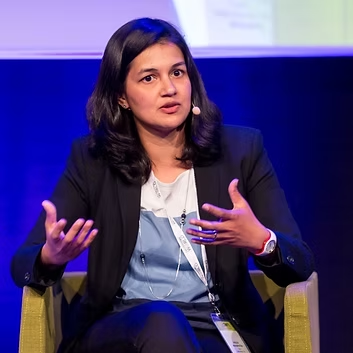
Biological data & public-private partnerships — Pooja Mahapatra, Head of Product, Climate & Nature at FUGRO
Marine biological data is hugely valuable but can be difficult to capture, standardise and use in real-world applications.
Fugro is a company that uses Geo-data solutions to enhance sustainable development and safety. The organisation joined several others to contribute to EMBRC’s Ocean Dialogues: a roundtable bringing together marine experts to share insights and discuss solutions for managing marine ecosystems in a sustainable way.
Here, Pooja Mahapatra, the organisation’s Head of Product – Climate & Nature, shares why ocean observation data is so important and how public-private partnerships can work together to boost its impact.
Understanding the ocean through data collection can support various asset owners, from offshore wind to telecom cables. Biological data, which is also notoriously difficult to capture, enables things like blue carbon accounting, marine spatial planning, or developing early warning systems for catastrophes such as weather phenomena, harmful algal blooms, or invasive species.
Biological systems are complex and dynamic at the best of times. In the ocean, it’s even more challenging because there are thousands and thousands of species living in hard-to-reach, high-pressure areas with low light conditions.
Also, it’s difficult to create metrics that compare things in an equitable way. The climate is easy in comparison because you measure any emission or mitigation effect with a standard unit: as a CO2 equivalent. Biodiversity is so difficult to define, not to mention the fact that they keep moving around all the time. Even if you do define and measure them, you only have a snapshot in time. In the next minute, your shoal of fish quickly moves away.
So it’s unhelpful to have static boundaries and laws, especially in the policy context when things take years to move. Decisions are being made based on data of one snapshot several years ago, which makes building a good sampling regime difficult. Even the most advanced tools are expensive and give you a snapshot in time. They can’t take into account the dynamism of life.
It’s also a question of money. Historically, investment goes towards things like weather forecasting and navigational safety rather than biodiversity. That’s because if you don’t see it, and it doesn’t directly affect your day-to-day life, it’s not a problem.
On the technology side, a great example is the work we’re doing to help the Government of Italy map their entire coastline for seagrass. These biodiverse habitats are a huge carbon store and protect coastlines against erosion. Despite its many benefits, seagrass is being lost at the rate of around 7% per year. That’s approximately a football field every 30 minutes.
If you don’t measure and understand where the seagrass is, how fast it is changing, and which human pressures are causing it to change, you can’t build anything meaningful in terms of restoration measures – especially over a large scale. Restoration is expensive and if you want to really make the biggest impact for your investment, you need to have the right data to make these decisions, such as which areas to focus on first.
Quite often academia doesn’t have enough funding and motivation to scale. A PhD student might complete their project after four years and then move on – there’s no incentive to scale up their solution. The private sector does have an incentive to scale while making costs as low as possible. That’s why public-private partnerships can add real value to the sector.
Fugro’s data quite often informs different kinds of policy reports. For example, we work with the UN Global Compact and the UN Ocean Decade, and I’m on the steering committee of the Global Ocean Observing System (GOOS). Having representation from the private sector in these kinds of organisations also helps to shape that policy direction.
The private sector does have an incentive to scale while making costs as low as possible. That’s why public-private partnerships can add real value to the sector.
Building tourism models that feed off a healthy ecosystem gives the tourism industry an incentive to maintain the quality of biodiversity in that region. That’s one kind of sustainable financing model. There are also blue bonds and carbon markets, which have to be data driven to maintain trust in the system. Lastly, there’s industry co-investment. Users of the blue economy – from offshore energy to shipping – benefit from healthy ocean ecosystems. Leveraging programmes to channel funds is especially important for early stage innovation in the ocean sector.
We need to target co-benefits that lead to conservation measures.
Collaborations between organisations like EMBRC and companies like Fugro are very beneficial. In academia, talented researchers are using cutting-edge technology to create brilliant solutions but, often, these can end up sitting on a shelf when the project is done. The private sector can really make a difference by scaling up that technology, standardising it, and making it widely used.
Especially with biodiversity, we lack standards to such a large extent. Fugro can support all the work that’s being done by initiatives like EMO BON to scale that up and create global standards. Tangible examples where these collaborations can work include autonomous eDNA samples, Digital Twins of the Ocean with a dynamic component powered by biological data, or maximising the value of video and satellite data using AI species recognition.
For more information about EMO BON, visit: EMO BON – Ocean Observation | EMBRC
To read EMBRC’s G20 policy recommendations from its Ocean Dialogue events, visit: EMBRC releases G20 policy recommendations
Watch EMBRC’s Ocean Dialogues roundtable
EMBRC’s Ocean Dialogues “Navigating the Blue Economy: Insights from Ocean Observation Data” is a roundtable where marine observation experts from its network, the Organisation for Economic Co-Operation and Development (OECD), The European Commission (DG MARE), FUGRO, London School of Economics and Political Science (LSE), and (4Climate s.àr.l.) discussed opportunities for sustainable marine management.
The panel stressed the need for global standards for marine biodiversity data, effective monitoring technologies, and equitable capacity building. Importantly, the Ocean Dialogues recognise the essential nature of biodiversity observation and aims to show that it has economic and environmental value as well as purely academic.