Climate change risks: boosting discoveries through research services
How EMBRC connects researchers to vital scientific services to study climate change through the EU-funded IRISCC project
One of the key areas of study for many researchers across Europe and beyond is the existential threat posed by the climate crisis.
Recognising the need for a comprehensive, unified response, Integrated Research Infrastructure Services for Climate Change Risks (IRISCC) brings together 14 leading European research infrastructures – including EMBRC – to empower society to understand, predict, and build resilience to climate change risks. Through IRISCC, researchers can access more than 100 services in support of their research.
Here, Pablo Serret, a lecturer at the University of Vigo, Vivi Pitta, research director at HCMR, and Davide Di Cioccio, access officer at EMBRC, share how EMBRC connects researchers with vital resources and services through this EU-funded project to study climate change impacts.
Vivi Pitta, research director at HCMR:
Crete is situated in the eastern Mediterranean, putting it at the lower end of the productivity gradient. This means that CretaCosmos is the only facility in the world where people can work with really oligotrophic conditions.
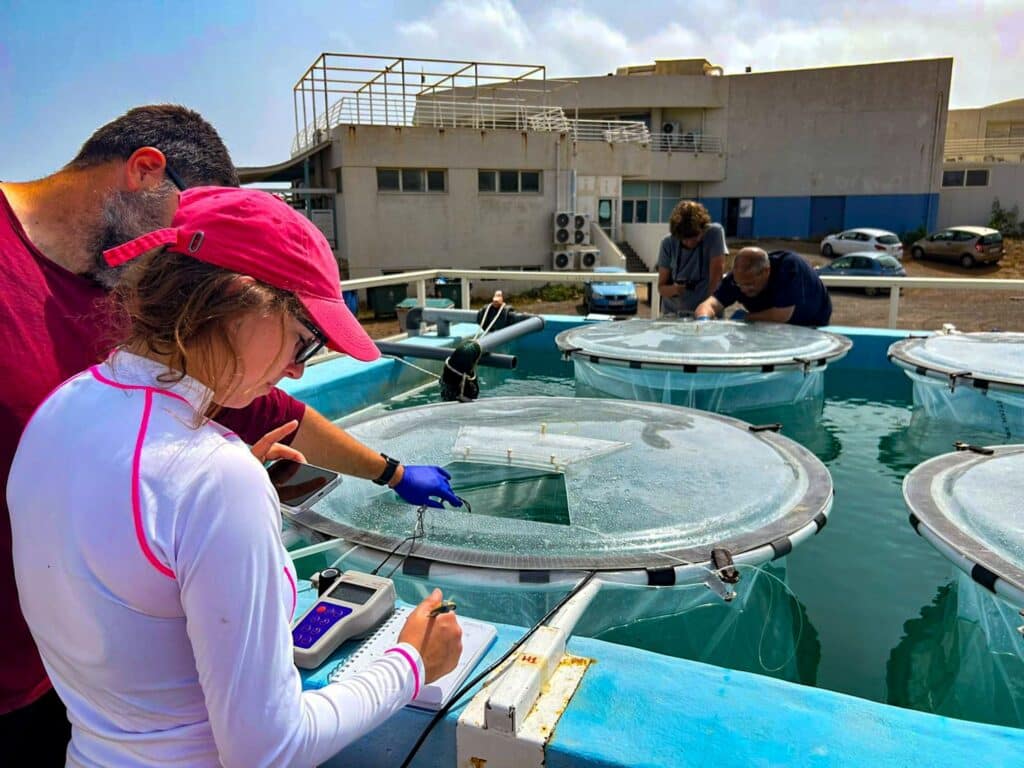
The HCMR mesocosm facility – CretaCosmos – comprises two large volume concrete pools (one 150 cubic metre pool and one 350 cubic metres) in which the mesocosms are incubated, enabling experiments around climate change and warming, Over the last 17 years, we’ve supported seven PhDs, four MSCs, and the publication of more than 40 papers with many more in the pipeline. We’ve welcomed more than 300 participants over more than 2,000 transnational access days and 17 experiments have been conducted.
Pablo Serret, reasearcher at University of Vigo:
Demo4 is a new, integrated service that explores indirect climate change risks from the need for mitigation technologies that are interacting with marine ecosystem services.
We know that it may be necessary to try to remove carbon dioxide from the atmosphere and companies are racing to develop suitable technologies. Institutions are trying to regulate while academics are trying to cope with the uncertainties around efficiency, efficacy, and risks posed to the marine environment.
Through the Demo4 service, we are trying to combine the two needs: to experiment at an ecosystem scale (through our mesocosm service) and cope with potential risks.
Carbon dioxide removal is a process happening on regional and global scales. We can give an overview of general risks but these will vary. We cannot expect the response will be the same in systems dominated by small phytoplankton with very little nutrients, compared with highly dynamic upwelling systems where cooling creates strong blooms that change rapidly. We need to be sure that when we assess the response of different ecosystems, we do it in a comparable manner.
Pablo Serret, researcher at University of Vigo:
We’ve created an integrated service with four EMBRC mesocosm facilities across a range of distinct European coastal ecosystems. These are in the Baltic Sea, the coastal lagoons in Vigo, Spain, a coastal lagoon in southern Portugal, and Crete’s Mediterranean Sea.
We are working to coordinate common experimental procedures that work across these different habitat types. We’re developing standard operating procedures through shared experimentation and creating a common data management pipeline that brings together the results from different experiments and makes them available to the community. This is all coordinated through the Institute of Natural Sciences in Belgium.
To do this, we’re creating experiments so we can share the protocols and methods, and generate data that can go into this data management pipeline. We’ve already carried out two experiments – one in the Baltic Sea and one in Vigo – and we’re planning a new experiment in Vigo in June 2026, which has three researchers joining through an Aquaserv open call.
We also have an upcoming experiment in Crete (14 September to 4 October) following IRISCC’s third open call.
Vivi Pitta, research director at HCMR:
The goal of this experiment is to investigate how nutrient addition enhances phytoplankton blooms. It will also explore how increase in phytoplankton biomass supports multiple ecosystem services, including biological carbon dioxide removal, mitigation of aquaculture derived nutrient waste, and biomass production for biotechnological applications.
There will be 12 pelagic mesocosms of three cubic metres each incubated in our 150 cubic metre pool. We will have 12 mesocosms with four triplicated treatments. Those with no treatment represent the ambient conditions of the sea. Some will have alkalinisation treatment as a chemical carbon removal strategy reference. The third treatment will add nutrients to simulate fish farms inducing phytoplankton growth. Lastly, nutrients will be added but zooplankton excluded to promote blooms under reduced grazing pressure.
We will measure a complete set of variables, such as pH, alkalinity, nutrient concentrations, chlorophyll, pigments, bacterial and viral production, plankton abundance and diversity, gross photosynthesis, community respiration and net community production, and metagenomes, metatranscriptomes, viromes and metabolomics. The beauty of a mesocosm experiment is that so many things can be examined.
Davide Di Cioccio, Access Unit Manager, EMBRC Headquarters:
EMBRC gives scientists from academia and industry access to a wide range of services across Europe to help them advance their studies more effectively. Our services are available through our catalogue on a fee basis, and researchers can access them free of charge through Transnational Access (TA) EU-funded projects in which EMBRC is a partner. By offering these two options, we’re making marine research development more accessible to the scientific community, accelerating scientific discovery and innovation.
IRISCC project
EMBRC provides cutting-edge, interdisciplinary, and customised services to help empower researchers and others stakeholders with research and facilities, driving effective climate action.