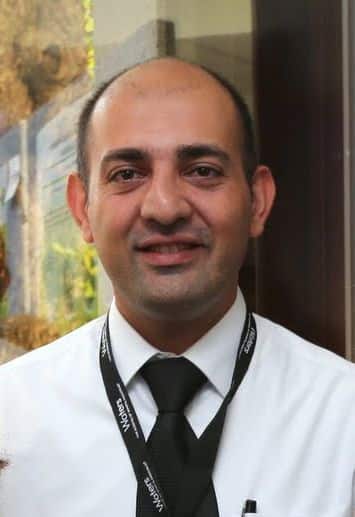
Daniel Kumazawa Morais is a molecular ecologist and bioinformatics specialist who guides the use of metabarcoding data to track changes in community structure. He builds Linux-based workflows and R-driven analytical pipelines, helping researchers apply effective computational solutions to complex ecological datasets.
News
Ocean Hackathon® Peniche: One weekend to create a game-changing product using EMO BON data
18 Dec 2025
A multidisciplinary team led by UiT (EMBRC Norway) created a platform that turns EMO BON data into information for policymakers.
In October, EMBRC joined the 9th edition of the annual Ocean Hackathon®. This initiative from Campus Mondial de la Mer, Technopôle Brest-Iroise aims to encourage and recognise initiatives that contribute to raising awareness of the sea, and aligns with our mission to maximise the global use of EMO BON’s genomic data.
During the 48-hour event, teams develop prototypes and explore their practical applications using marine data. On the same weekend, 10 of these events took place in different cities all around the world.
In Peniche, Portugal, EMBRC’s Daniel Kumazawa Morais, a senior bioinformatics engineer at UiT – the Arctic University of Norway led a team that created a product that uses EMO BON data to visualise species distribution, biodiversity loss, and anthropogenic activity.
Kumazawa Morais’ team came third overall. The judges gave them 26.7 points out of a possible 34 (and close behind the winning team, which scored 27.4 points). We met with him to find out more about the experience.

Meet Daniel Kumazawa Morais, senior bioinformatics engineer at the Arctic University of Norway

What was the concept behind your Ocean Hackathon Challenge?
The idea was to build an interactive web tool that explores marine biodiversity across Europe using data from EMO BON, EMODnet, and Global Fishing Watch.
By crossing EMO BON data with anthropogenic activities and environmental variables, we could visualise species distribution, increases or decreases in diversity, and the environmental context – with a particular focus on endangered species. For example, using Global Fishing Watch to get an idea of fishing efforts in areas around EMO BON stations and creating a map where people could see data around their organism of interest. Another use idea would be to predict whales’ locations from the EMO BON and EMODNET data to optimise vessel routing and minimise ship-whale collisions. We wanted this multidisciplinary tool to help turn data into something that can inform positive policy decisions.
What was the Hackathon like?
There was definitely a competitive element between the teams – everybody wanted to win so the teams were working really hard. To start with, as we got to know each other and shared our skills, it was brilliant. Everyone was really engaged in getting to grips with the challenge. As time went on, there were tense moments and friction between tired team members. But we made sure to have breaks, go out for walks, and come back to our pitch refreshed. This helped us focus on our idea and what was actually possible in the time – we had around 16 hours to work on the product because there were other sessions and networking running – and we were really pleased with what we managed in those hours.
What stage did the team reach with the product at the end of the Hackathon?
We had a prototype: a map with some functions to select taxa we were interested in. We’d hoped to add all the fishes or mammals but, due to the limited time, it wasn’t possible to code them all. In the end, we chose blue sharks and a specific algae that was contributing to algal blooms. Then we had environmental variables that we could check to see any correlations. So we had a working product that we could demonstrate in our pitch – but more work is still needed to build deeper functionality.
Is the team continuing to work on the product?
Yes. We have a WhatsApp group for all the team members to collaborate on a proposal for industry support in creating a fully functioning product out of this.
What did you learn from the Hackathon experience?
I was surprised how much we achieved during the limited time we had, and it was great to get so many new points of view from our multidisciplinary team. Initially, my main focus was on monitoring the biodiversity crisis to see how human activity was decreasing biodiversity. But Zane Estere Gruntmane, one of the team members, pointed out that we should give this a positive twist as part of our technology delivery strategy: instead of talking about loss, we could talk about what actions could improve the environment and how this tool could help to make things more sustainable.
The challenge also highlighted that the raw sequencing data generated by EMO BON needs a lot of computing power to process – it’s not yet plug and play. So it’s useful for partners to know that it does need a specialist to convert this sequencing data into the presence and absence of species, as this can be very complex. We had around two million hours of computing activity behind the data we were using.
News